Hair loss
Consultation for hair loss
If your hair is thinning or falling out, a consultation at our Clayhall clinic in Ilford is a place to start. We look at your scalp, ask about your health and family history, and talk through possible causes and options. Sometimes the right next step is a blood test or a visit to your GP.
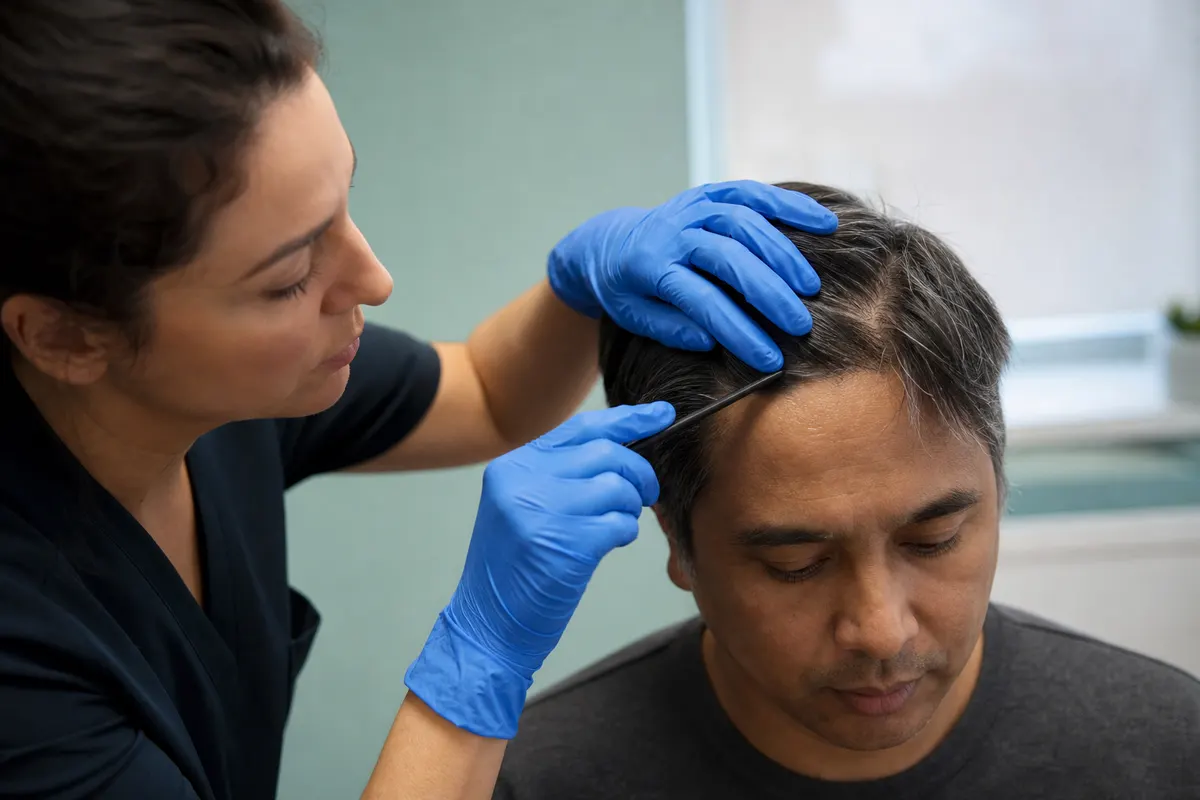
- Starts with A consultation
- May include A blood test, if useful
- With Sharmila Selvarajah
- Where 420 Clayhall Avenue, Ilford IG5 0SH
What we look at
Hair loss has many causes, so we start with you.
- When it started, and how quickly it has changed
- Your health, your diet and any recent stress or illness
- Hair loss in your family
- Your options, which may include seeing your GP
When to get medical help first. See your GP if your hair loss is sudden, comes in patches, or your scalp is sore or itchy.
Common reasons hair falls out
Everyone sheds some hair every day, and most people do not notice it. When hair loss does become noticeable, the cause makes a big difference to what happens next.
The NHS describes male and female pattern baldness as permanent hair loss that usually runs in families. Temporary hair loss can follow illness, stress, cancer treatment, weight loss or low iron.
The NHS also says most hair loss does not need treatment, either because it is temporary or because it is a normal part of ageing. Hair loss caused by a medical condition often stops once you recover. No treatment works for everyone, and you should be wary of anyone who says otherwise.
When to see your GP first
NHS advice is to speak to a GP before you go to a commercial hair clinic, to find out what is causing your hair loss. We think that is good advice, and it applies to us too. A GP can often identify the cause by looking at your hair, and it is not usually urgent.
Tell your GP if your hair loss is affecting how you feel. They may be able to arrange counselling. Alopecia UK has a directory of local support groups, and Cancer Research UK and Macmillan have information if your hair loss is linked to cancer treatment.
Hair loss can be hard to live with, even when nothing is medically wrong. You do not need to rush any decision, and doing nothing is a reasonable choice.
Questions to ask any hair clinic
Hair loss is an area where promises come easily. Ask these wherever you go, including here:
- What do you think is causing my hair loss, and how do you know?
- Should I have any tests, or see my GP, before going further?
- Who will see me, what are their qualifications, and which register are they on?
- What is the evidence for anything you suggest, in people with my type of hair loss?
- What are the side effects, and what happens if I stop?
- What is the total cost, including any further visits?
- What will you do if you think nothing here will help me?
If anyone guarantees a result, or pushes you to pay for a course on the first visit, take your time and get a second opinion. You should be free to leave a consultation with nothing more than a clearer idea of what is going on.
What happens
It always starts with a conversation, and there is no pressure.
-

Holding image 1Consultation
We talk through your concerns, your health history and your options.
-

Holding image 2An honest assessment
We tell you what is realistic, what the risks are, and whether treatment is suitable for you.
-

Holding image 3Aftercare
If you go ahead, you get clear aftercare advice and know how to reach us.
Who treats you
Your consultation covers your health history before any treatment is discussed. Sharmila Selvarajah carries out the consultation herself.
Questions people ask
Is hair loss always permanent?
No. Some kinds of hair loss are temporary. The cause makes a difference.
Should I see my GP first?
If it is sudden or patchy, or your scalp is sore, yes.
Can you promise my hair will grow back?
No one can honestly promise that. We will tell you what is realistic.
Where to next
Ready when you are
- 420 Clayhall Avenue, Ilford IG5 0SH
- Mon to Fri 9am to 7pm, Sat 9am to 2pm
- 07401 494728
- WhatsApp us
- Free street parking. Two steps at the entrance.